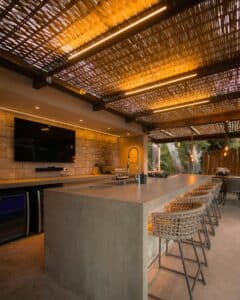
Why Outdoor Countertops Are Different From Indoor Countertops
Outdoor countertops deal with conditions that indoor kitchens never face. Heat from grills, direct sunlight, moisture from weather, and constant exposure to grease all happen at the same time. That combination changes how materials behave.
Indoor materials are designed for controlled environments. Outside, surfaces expand and contract, fade under UV exposure, and absorb moisture if they are not built to resist it. This is why materials that look good in a showroom can fail quickly once installed outdoors.
Many of the durability issues homeowners run into start with this exact misunderstanding. Choosing a countertop based on appearance instead of performance is one of the patterns that shows up repeatedly in common outdoor kitchen mistakes, especially when materials are selected without considering long-term exposure.
Before comparing options, it is important to understand that outdoor countertops are less about style and more about how well they handle stress over time.
What Makes a Good Outdoor Countertop Material
A good outdoor countertop is defined by how it performs, not just how it looks. There are a few key criteria that determine whether a material will hold up or fail.
Heat resistance
Grills generate high, direct heat. Materials that cannot handle temperature swings can crack, warp, or discolor over time.
Weather durability
Rain, humidity, and temperature changes affect structural integrity. Outdoor-rated materials resist expansion, contraction, and moisture damage.
Stain resistance
Grease, food residue, and outdoor debris settle into porous surfaces. Materials that resist staining are easier to maintain and last longer.
Maintenance requirements
Some materials require sealing, polishing, or regular upkeep. Others are more forgiving and easier to maintain with basic cleaning.
Structural strength
Outdoor countertops need to support weight and resist movement. Weak materials can crack or shift as the base settles or expands.
Each of these factors directly impacts longevity. Ignoring even one often leads to repairs or replacement much sooner than expected.
Best Outdoor Countertop Materials (Side-by-Side Comparison)
When comparing materials, the goal is not to find a perfect option. It is to understand trade-offs.
Granite
Pros
- Excellent heat resistance
- Handles outdoor exposure well
- Strong and durable
Cons
- Requires periodic sealing
- Can stain if not maintained
Best for: homeowners who want a balance of durability and natural appearance.
Concrete
Pros
- Highly customizable
- Strong and long-lasting when sealed properly
- Can be formed to fit any layout
Cons
- Requires sealing and maintenance
- Can develop hairline cracks over time
Best for: custom kitchens where shape and design flexibility matter.
Stainless Steel
Pros
- Extremely durable
- Resistant to heat and moisture
- Easy to clean
Cons
- Shows fingerprints and scratches
- Industrial appearance may not fit all designs
Best for: modern kitchens or heavy-use cooking setups.
Tile
Pros
- Lower upfront cost
- Wide variety of styles
Cons
- Grout lines stain and require upkeep
- Can crack or loosen over time
Best for: budget-conscious builds where maintenance is expected.
Materials to Avoid for Outdoor Kitchens
Some countertop materials look appealing at first but fail quickly once exposed to outdoor conditions. These failures are predictable and usually tied to heat, UV exposure, and moisture.
Quartz
Quartz performs well indoors but struggles outside. UV exposure can cause discoloration and breakdown of the binding resins. Over time, this leads to fading and surface damage, especially in direct sunlight.
Laminate
Laminate is not designed for outdoor use. Moisture can seep into seams, causing swelling and separation. Heat from grills can also damage the surface quickly.
Indoor wood surfaces
Wood can work in covered, controlled environments, but in most outdoor kitchens it requires constant sealing and maintenance. Without that upkeep, it warps, cracks, and absorbs moisture.
These materials are not inherently bad. They are just not suited for the environment. Choosing them often leads to early replacement, which increases long-term cost.
Cost vs Durability – What Actually Lasts
The cheapest countertop upfront is rarely the cheapest over time. Outdoor kitchens are exposed to constant wear, and materials that cannot handle that exposure usually require repair or replacement.
A simple way to think about it:
- Lower upfront cost
Often means higher maintenance and shorter lifespan - Higher upfront cost
Usually means better durability and less long-term upkeep
Granite and stainless steel tend to hold up well over time, while tile and lower-cost options often require more maintenance. Concrete sits in the middle, offering durability with the trade-off of ongoing sealing.
This is why material choice directly affects total project cost. It is not just about installation. It is about how the kitchen performs years later, which is a key factor when understanding how much an outdoor kitchen costs beyond the initial build.
How to Choose the Right Countertop for Your Setup
The best material depends on how the kitchen will be used and what conditions it will face.
For frequent cooking and high heat
Granite or stainless steel are reliable choices. They handle heat well and require less intervention during use.
For custom layouts and design flexibility
Concrete offers the ability to shape and size countertops exactly as needed, but it requires more maintenance.
For budget-focused builds
Tile can work if the homeowner is comfortable with upkeep and understands its limitations.
For low-maintenance preference
Stainless steel is often the easiest to maintain, though it comes with aesthetic trade-offs.
There is no single “best” material for every situation. The right choice is the one that balances durability, maintenance, and how the space will actually be used.
Bottom Line – What Material Is Actually “Best”
The best outdoor kitchen countertop material is the one that performs consistently under real conditions. Granite, concrete, and stainless steel are the most reliable options because they handle heat, weather, and regular use without failing quickly.
Materials like quartz, laminate, and untreated wood often create problems because they are not built for outdoor exposure. Choosing them usually leads to higher long-term costs, even if the initial price is lower.
In simple terms, durability matters more than appearance. A countertop that holds up over time will always outperform one that looks good on day one but struggles with outdoor conditions.