Introduction
Steam cleaning has become a popular alternative to harsh chemicals and aggressive scrubbing, so it’s no surprise grill owners are asking the same question: can you use a steam cleaner on a grill?
On the surface, it sounds ideal. Steam is hot, chemical-free, and effective at breaking down grease in kitchens and bathrooms. But grills are a different environment entirely. They deal with extreme heat, baked-on carbon, grease fires, and internal components that aren’t designed to get wet.
The short answer is yes, steam cleaning can work on a grill — but only in certain situations, on certain parts, and with clear limitations. In this guide, we’ll explain how steam cleaning actually works, where it’s effective, where it falls short, and how professional steam cleaning differs from what most homeowners can do themselves.
How Steam Cleaning a Grill Actually Works
Steam cleaning uses high-temperature vapor to loosen grease, carbon, and bacteria without relying on chemicals. Instead of dissolving buildup chemically, steam works by penetrating it with heat and moisture, softening hardened residue so it can be wiped or lifted away.
On grills, this approach has a few major advantages:
- No chemical residue left behind on food-contact surfaces
- Safe for many materials, including stainless steel and cast iron
- Effective against grease and bacteria, especially in enclosed areas
This is why steam plays such a big role in professional grill cleaning. At Fire & Metal, steam is a core part of our full grill cleaning service, because it sanitizes and degreases without damaging finishes or introducing harsh cleaners.
That said, steam isn’t magic. Temperature, pressure, and access all matter. Consumer steam cleaners operate at much lower pressure than commercial systems, which limits what they can realistically remove.
Understanding where steam works best is the key to using it correctly.
What Parts of a Grill Steam Cleaning Works Best On
Steam cleaning is most effective on areas where grease and residue sit on the surface rather than deep inside metal or mechanical systems.
Grill grates
Steam works well on stainless steel and cast iron grates with light to moderate buildup. It loosens grease and carbon so they can be wiped away, especially when paired with a brush or scraper. For heavy buildup or rust, steam alone usually isn’t enough, which is why tools and follow-up cleaning still matter. Our guide on what tools work best for grill cleaning breaks this down further.
Firebox interior
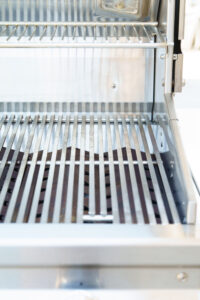
This is one of steam’s biggest strengths. Steam penetrates corners and seams inside the firebox where grease and carbon accumulate. It helps eliminate odors and reduces flare-up risk by removing fuel sources you can’t reach with a brush alone.
Drip trays and grease channels
Steam softens thick grease buildup that’s difficult to scrape when cold. This is especially useful in areas that contribute to grease fires if left untreated.
Exterior stainless steel surfaces
Steam lifts grime and residue without scratching or dulling stainless finishes. When followed by proper drying and polishing, it restores a clean, uniform look without abrasive cleaners.
Where steam is not effective is just as important. It won’t fix clogged burners, corroded ignition systems, or deep rust issues. Those fall under maintenance and repair, which we cover in detail in our guide on why grills stop heating evenly.
Where Consumer Steam Cleaners Fall Short
This is where expectations need to be set honestly. While steam cleaning sounds powerful, most consumer-grade steam cleaners have real limitations when it comes to grills.
Limited temperature and pressure
Home steam cleaners simply don’t reach the temperature or pressure needed to break down thick, baked-on carbon. They’re great for loosening grease, but once buildup has hardened over multiple seasons, steam alone won’t fully remove it.
Can’t reach internal systems
Burners, venturi tubes, ignition systems, and gas channels should never be exposed to uncontrolled moisture. Consumer steamers can’t safely or effectively clean these areas, and trying to force steam into them can actually cause corrosion or ignition issues later.
No mechanical agitation
Steam works best when paired with brushing, scraping, or wiping. On its own, it rarely removes buildup completely. That’s why people often feel like steam “helped, but didn’t finish the job.”
Risk of trapped moisture
If parts aren’t fully dried afterward, steam can introduce moisture into seams and joints, accelerating rust. This is especially common in humid or coastal environments.
In short, consumer steam cleaners are best viewed as a supporting tool, not a full grill-cleaning solution.
Steam Cleaning vs Traditional Grill Cleaning Methods
To understand where steam fits, it helps to compare it directly with other common methods.
Steam vs wire brushes
Brushes physically remove carbon and debris, making them effective for regular maintenance. Steam is gentler and safer for surfaces, but slower and less aggressive. Used together, they’re far more effective than either alone.
Steam vs chemical degreasers
Degreasers break down grease quickly but can leave residue if not rinsed thoroughly. Steam avoids chemicals altogether, which is why it’s safer for food-contact areas. That’s also why Fire & Metal avoids harsh cleaners entirely in favor of steam-based processes.
Steam vs power washing
Power washing is one of the worst things you can do to a grill. High-pressure water forces grease and debris into burners and gas lines, leading to clogs, corrosion, and ignition failure. Steam uses heat, not force, making it far safer when done correctly.
If you want a deeper breakdown of safe cleaning approaches, our step-by-step guide on how to deep clean a grill explains which methods to combine and which to avoid entirely.
When Steam Cleaning Is Enough — and When It Isn’t
Steam cleaning works best when used at the right time.
Steam is usually enough when:
- Buildup is light to moderate
- The grill is cleaned regularly
- Odors are present but not overpowering
- You’re maintaining, not restoring
In these cases, steam can refresh your grill, sanitize surfaces, and reduce grease without heavy scrubbing.
Steam is not enough when:
- Grease and carbon are layered and hardened
- Burners are clogged or corroded
- Heat distribution is uneven
- Strong odors persist after cleaning
- Rust has already formed
At that point, steam becomes part of a larger solution, not the solution itself. This is where professional disassembly, internal cleaning, and inspection make the difference between a temporary improvement and a real fix.
How Professional Steam Cleaning Is Different
Professional steam cleaning isn’t just a stronger version of what you can do at home. The difference comes down to temperature, pressure, access, and process.
Commercial steam systems operate at much higher temperatures and controlled pressure, which allows grease and carbon to be broken down without forcing moisture into places it shouldn’t go. Just as important, professional cleaning involves partial or full disassembly, so buildup is removed from areas most homeowners can’t safely reach.
At Fire & Metal, steam cleaning is combined with detailed inspection, manual agitation where needed, and proper drying before reassembly. This prevents moisture-related rust and ensures burners, ignition systems, and airflow channels aren’t compromised in the process. That’s why our approach is part of a full-service grill restoration, not a surface-level clean. You can learn more about how we approach this on our About page.
Professional steam cleaning is best when a grill hasn’t been serviced in a long time, has lingering odors, uneven heat, or grease buildup that keeps coming back no matter how often it’s cleaned at home.
Conclusion
So, can you use a steam cleaner on a grill? Yes — with limits.
TL;DR: Steam cleaning works well for light to moderate grease, firebox interiors, drip trays, and stainless steel surfaces. Consumer steam cleaners are helpful for maintenance but fall short for heavy buildup, internal systems, and long-neglected grills. When steam is used professionally, with proper disassembly and drying, it becomes one of the safest and most effective ways to restore a grill.
When steam cleaning isn’t enough on its own, Fire & Metal provides professional grill cleaning throughout the Bay Area to safely remove buildup, restore performance, and help your grill last longer.