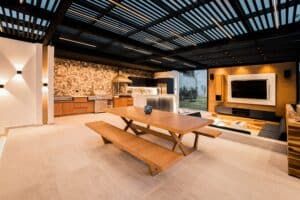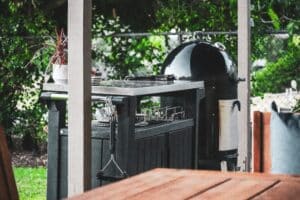
An outdoor kitchen doesn’t need to be huge to work well. In fact, a smaller kitchen with enough preparation space and thoughtfully placed appliances can be much easier to cook in than an oversized layout filled with features you rarely use.
The right size depends on what you want to do outside.
A homeowner who wants a built-in grill, storage, and some counter space needs a very different setup from someone planning a grill, refrigerator, sink, pizza oven, multiple burners, seating, and space for entertaining.
Instead of starting with square footage, start with what the kitchen needs to accomplish. The dimensions should follow from there.
What Is a Good Size for an Outdoor Kitchen?
There’s no universal ideal size, but outdoor kitchens can generally be thought of in three categories.
| Kitchen Type | Typically Includes | Best For |
|---|---|---|
| Compact | Grill, storage, prep space | Everyday grilling |
| Medium | Grill, refrigerator, storage, larger counters | Cooking complete meals |
| Large | Multiple cooking appliances, sink, refrigeration, extensive storage | Frequent entertaining |
The actual dimensions can vary considerably within each category because appliance sizes and layouts differ.
For example, adding a refrigerator doesn’t only require enough width for the appliance. You also need ventilation, door clearance, and usable counter space around it.
That’s why simply saying an outdoor kitchen should be a certain number of feet long doesn’t tell you very much.
How Much Space Does a Basic Grill Station Need?
A basic grill station can be surprisingly compact.
At minimum, you’ll typically want space for:
- Built-in grill
- Landing space beside the grill
- Food preparation
- Storage underneath
- Safe clearances required by the grill manufacturer
The biggest mistake is making the grill consume nearly the entire countertop.
Imagine a six-foot island with a large grill in the center but almost nowhere to put a tray of raw food, season vegetables, or set down finished steaks. Technically, you have an outdoor kitchen. Functionally, you’ve built a grill surround.
Counter space is part of the cooking equipment.
For a compact kitchen, we’d rather prioritize a quality grill with genuinely useful workspace than squeeze several appliances into an undersized island.
How Much Bigger Does a Full Outdoor Kitchen Need to Be?
The kitchen needs to grow as additional functions are added.
Consider what happens when you add:
A refrigerator: You need appliance width, ventilation, electrical access, and door clearance.
A sink: You lose countertop and cabinet space while adding plumbing underneath.
A side burner: You need another appliance cutout plus useful separation from the grill.
A pizza oven: You may need significant countertop area, heat clearances, and additional preparation space.
Seating: Now you need to think beyond the cooking zone and account for people sitting, walking, and interacting around it.
This is why appliance selection should happen before finalizing the dimensions. Otherwise, homeowners often end up either squeezing too much equipment into the kitchen or making the structure much larger than it needs to be.
How Much Counter Space Does an Outdoor Kitchen Need?
Counter space is one of the easiest things to underestimate when designing an outdoor kitchen.
You need somewhere to put food before it goes onto the grill and somewhere for it to go after it’s cooked. You also need room for cutting boards, trays, seasonings, utensils, drinks, and anything else you’re using during the meal.
Rather than focusing on one universal measurement, think about creating three useful areas:
- Prep space for cutting, seasoning, and assembling food
- Landing space immediately beside major cooking appliances
- Serving space where finished food can sit without interfering with cooking
A long countertop isn’t automatically useful if appliances divide it into several tiny sections. One uninterrupted prep area can be more practical than the same amount of counter scattered throughout the kitchen.
Don’t Forget Working and Walking Space
The dimensions of the cabinets are only part of the outdoor kitchen’s footprint.
You also need enough room to comfortably stand, cook, open appliances, and move around other people.
This becomes especially important with:
- Refrigerator doors
- Cabinet drawers
- Grill lids
- Trash pullouts
- Bar seating
- Opposing countertops
- Multiple people cooking at once
For example, an island might technically fit on a patio while leaving so little room behind the cook that guests constantly have to squeeze past.
Think beyond whether everything fits. Ask whether everything can be used at the same time.
If opening the refrigerator blocks the main walkway or someone sitting at the counter prevents the cook from reaching a cabinet, the layout is too tight even if it looks fine on paper.
What Size Outdoor Kitchen Fits Your Needs?
A useful way to approach sizing is to start with how you’ll actually use the space.
| If You Mainly Want To… | Consider |
|---|---|
| Grill simple meals | Grill + prep counter + storage |
| Cook complete meals outside | Grill + generous prep + storage + select appliances |
| Entertain regularly | Larger cooking zone + refrigeration + serving space |
| Make the kitchen mostly independent from indoors | Grill + refrigeration + sink + storage + prep space |
| Use several cooking methods | Multiple cooking appliances + larger prep and landing areas |
Notice that the goal isn’t to fit every possible feature.
A homeowner who grills four nights a week may get far more value from additional prep space than from a pizza oven used twice per year.
Why Bigger Isn’t Always Better
A larger outdoor kitchen can provide more storage and equipment, but unnecessary size can actually make cooking less convenient.
If the refrigerator is at one end, the sink at another, and the grill several steps away, you’re constantly moving between work areas.
A good kitchen keeps frequently used components reasonably close together while still providing enough room to work safely and comfortably.
There’s also the cost consideration. Increasing the kitchen’s size can mean more:
- Cabinetry
- Countertop material
- Structural work
- Utilities
- Flooring or patio space
Instead of asking, “How large can we make it?” ask, “What is the smallest layout that comfortably does everything we want?”
That’s usually a much better starting point.
Bottom Line: How Big Should an Outdoor Kitchen Be?
An outdoor kitchen should be large enough to accommodate your essential appliances, comfortable preparation space, storage, and movement without becoming unnecessarily oversized.
Start with how you cook. Choose the appliances you’ll genuinely use. Then build enough space around those appliances for preparation, serving, storage, and traffic.
A compact grill station may be all one household needs. Another may benefit from a larger kitchen with refrigeration, plumbing, multiple cooking appliances, and seating. Neither is inherently better.
For a permanent project, Fire & Metal can plan a custom outdoor kitchen design and installation around the available space and how you actually intend to use it.