Introduction
Every grill reaches a point where regular brushing just doesn’t cut it. Grease starts to pool in corners, food residue bakes into the grates, and that once-clean firebox begins to smell more like old smoke than grilled food. When that happens, it’s time for a deep clean.
A deep clean isn’t about making your grill look new — it’s about restoring performance and safety. Built-up grease and carbon can cause flare-ups, clogged burners, and uneven heating. Over time, that buildup can even lead to corrosion inside your grill.
This step-by-step guide walks you through how to deep clean your grill safely, what tools and cleaners you’ll need, and how professional cleaning compares when your grill needs more than a quick scrub.
When Should You Deep Clean Your Grill?
Most homeowners don’t deep clean their grill nearly as often as they should. Even if you’re cleaning the grates regularly, residue still builds up inside the firebox and burners over time.
You should plan for a full deep clean:
- Every 3–6 months if you grill regularly (1–2 times a week)
- Before and after the main grilling season if you use it seasonally
- Anytime you notice these signs:
- Excessive smoke even when the grill is empty
- Grease fires or flare-ups that happen frequently
- Uneven heat or burners that sputter
- Strong, burnt smells coming from the grill when it’s off
Skipping deep cleaning shortens your grill’s lifespan and affects how your food cooks. A dirty grill doesn’t just look bad — it performs poorly, and it’s less safe to use.
Tools and Materials You’ll Need
Before you start your deep clean, gather everything you’ll need so the process goes smoothly. You don’t need expensive products — most of this can be found in your kitchen or garage.
Basic tools:
- Grill brush or cleaning brick
- Metal or wood scraper
- Heavy-duty scouring pads or sponges
- Microfiber cloths or paper towels
- Bucket or large tub for soaking
Cleaners:
- Warm, soapy water
- White vinegar (cuts grease and odor)
- Baking soda (gentle abrasive for buildup)
- Optional: a food-safe degreaser for stubborn residue
Safety items:
- Gloves (for grip and protection)
- Eye protection if you’re scraping or using degreasers
- A tarp or cardboard under the grill if cleaning outdoors
If your grill has removable parts like flavorizer bars, heat shields, or drip trays, take them out before starting. This helps you reach every area without risking damage.
Step-by-Step: How to Deep Clean a Grill
A proper deep clean follows a simple sequence — burn off, break down, scrub, and reassemble. Taking it in steps makes it easy to do safely and thoroughly.
Step 1: Burn off residue
Turn on all burners and close the lid. Let the grill heat up for 10–15 minutes to loosen grease and charred food particles. Then turn it off and let it cool until warm to the touch.
Step 2: Disassemble and soak parts
Remove grates, heat shields, flavorizer bars, and drip trays. Soak them in a mixture of hot, soapy water (or vinegar and baking soda) for 20–30 minutes. This breaks down grease and softens carbon buildup.
Step 3: Clean the burners
Use a soft brush or toothpick to clear any blocked burner holes. Avoid poking too hard or using metal tools that can enlarge the openings. If burners are removable, rinse and dry them before reinstalling.
Step 4: Scrape the firebox
Use a scraper or putty knife to remove thick grease and carbon buildup inside the grill. Wipe with paper towels and follow with a scouring pad dipped in warm water or mild degreaser. Rinse and dry thoroughly.
Step 5: Rinse, dry, and reassemble
Rinse all removable parts with clean water and dry them completely before reassembling the grill. Run the grill on low heat for 10 minutes to evaporate any remaining moisture before oiling the grates.
Following this process removes years of buildup, restores airflow, and helps your grill heat evenly again.
How Professional Deep Cleaning Differs
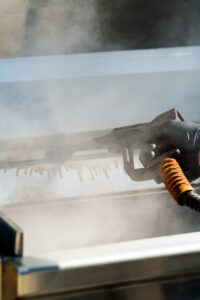
Even a careful deep clean at home only goes so far. Professionals use high-powered steam cleaning systems and specialized tools to reach the internal parts most homeowners can’t safely access — the firebox, burner ports, ignition wiring, and ventilation channels.
At Fire & Metal, our grill cleaning service uses a chemical-free, steam-based approach that sanitizes your grill while removing grease, soot, and carcinogenic buildup from every component. We also check for loose fittings, damaged hoses, and potential safety risks, helping extend your grill’s life in the process.
A professional deep clean doesn’t just make your grill look spotless — it restores full heat output, removes odors, and ensures your food cooks evenly again.
Conclusion
A deep clean might sound like extra work, but it’s one of the easiest ways to protect your grill investment and improve every cookout. Regular brushing keeps your grill usable, but deep cleaning brings it back to like-new performance.
TL;DR: Deep clean your grill every 3–6 months, especially before and after the grilling season. Disassemble, soak, scrub, rinse, and reassemble — and always let it dry fully before relighting. For buildup that won’t budge, professional cleaning is the safest and most thorough solution.
For more detailed care tips, check out our guide on the best grill cleaning tools.
Whether you’re cleaning it yourself or bringing in professionals, a deep clean restores flavor, improves performance, and keeps your grill cooking strong for years.